
“Allison After NXIVM” — the podcast featuring “Smallville” star Allison Mack, who became both a perpetrator and victim within Keith Raniere’s NXIVM sex cult — concludes on Dec. 15 with the release of its seventh and final episode. The podcast, written and hosted by Natalie Robehmed, and produced by Campside Media’s Vanessa Grigoriadis for CBC’s “Uncover,” is Mack’s first time telling her story, even though there’s been rabid attention on NXVIM and Raniere for years. Mack went to federal prison for nearly two years for her crimes within NXIVM, and was released in July 2023.
Throughout “Allison After NXIVM,” Mack, 43, has recounted how she first became involved in the cult in 2006 in Vancouver through “Smallville” co-star Kristin Kreuk. After the show ended, having completely fallen under Raniere’s spell, Mack moved outside of Albany, New York, where she became a high-up member of NXIVM, and one of Raniere’s harem. She had coercive sex with him daily in 2015-2016, which she thought was part of her healing journey.
When Raniere suggested that women within the cult form a subgroup called DOS, in which they were “masters” and had “slaves,” and engaged in branding rituals and had ultra-restrictive calorie limits, Mack, by then brainwashed, embraced this idea, and became both an enthusiastic recruiter and a harsh taskmaster to her “slaves.” Raniere and other members of NXIVM, including Mack, were arrested in 2018, and the podcast also tells the story of his trial, which Grigoriadis covered. “Allison After NXIVM” also has the first-ever interview with Lauren Salzman, the daughter of NXIVM co-founder Nancy Salzman. Lauren Salzman testified against Raniere at his trial, and was sentenced in 2021 to time served and five years of probation, after having pleaded guilty.
After years of staying silent, Mack chose to tell her story in podcast form because, as Robehmed says simply in the first episode, “she loves podcasts, and because she’s no longer comfortable in front of cameras like she used to be.” “Allison After NXIVM” is regularly in Apple Podcast’s Top 15 in the true crime category, and in its Top 100 overall. The series feels like a throwback — a documentary true-crime project with a singular focus — to the earlier days of the medium, when in 2014 Sarah Koenig’s “Serial” exploded, and showed what podcasting could do. In an interview over Zoom last week along with Robehmed, Grigoriadis, one of the founders of Campside, says: “To me, this is what this medium is made for: a confession. A confession, and a window into somebody’s life that you never could have imagined, but feels like something you can suddenly relate to.”
Robehmed echoes that sentiment, saying, “I still think there is real value to longform storytelling writ large.” The serialized format that “Allison After NXIVM” uses — as opposed to the one-off, crime-of-the-week podcasts that largely dominate the charts today — especially suits the complexities of Mack’s story. “It’s so intimate, and allows you the breadth and width to explore the ambiguities, and take the listener along on a journey that you, frankly, as a writer you don’t get to,” Robehmed adds.
Keith Raniere
YouTube
There are those, of course, who don’t think Mack should be allowed to speak publicly at all, or given a medium to do so. The idea of “platforming” someone who’s done wrong has become an increasingly vexed matter in our current state of toxic discourse. These are questions that Robehmed and Grigoriadis grapple with directly in the interview below, as they also detail how Salzman came to be interviewed only by happenstance, the emotional toll of doing this kind of reporting on — and whether there are any untold NXIVM stories left.
On the podcast, Natalie, you talk about your initial hesitation to do this project, saying you didn’t want to be part of Allison Mack’s redemption tour. Can you talk about how you got past that?
Natalie Robehmed: I think it’s for every person to go and listen for themselves and decide whether this does redeem her in any way — I’m not there to comment on that.
I thought the most interesting thing was getting to see somebody still working through coming out of a cult, and working through coming out of this incredibly programmed way of thinking. Also, coming to terms with the bad things that they’d done. I felt that that what was to be gained from getting that insight was really valuable, and worth doing the story.
And Vanessa, you’d interviewed Allison in 2018 for the New York Times in a NXIVM-sanctioned interview — when she flat-out lied to you about pretty much everything. Did she seem then like she was lying? And when you met her again to discuss this podcast, was she different?
Vanessa Grigoriadis: Definitely. She seemed so different. When I met her, she was incredibly thin, right? Because she was doing serious calorie restriction. She was extremely performative. She felt like she was a puppet of Keith’s. And even the fact that she had granted that interview in 2018 was part of NXIVIM’s media strategy to try to counteract the indictments that they thought were coming. So, she was being used, really.
You still feel when you’re talking to her that this is somebody who tells a really good story, and has an incredible sense of timing, and knows how to bring out the humor in a situation. But she struck me as much more analytical, much more intelligent. Much older — which she was, and she went through a lot. But also, Keith had reduced them to, like, adolescent girls, where they were all very like, “I’m the best! I’m better than her.” That was his whole thing, you know?
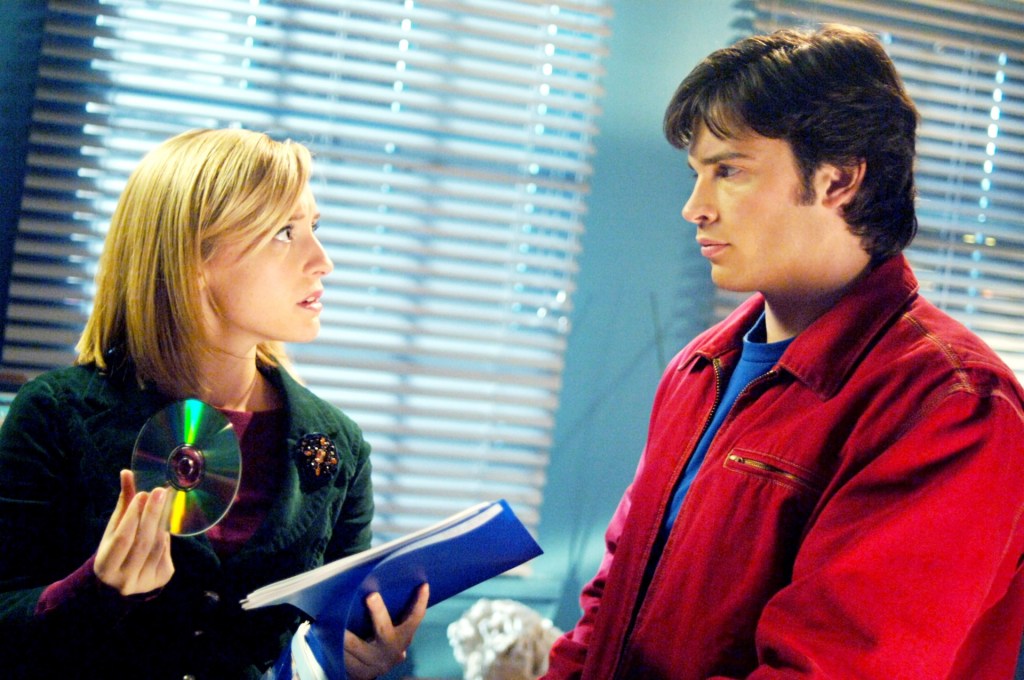
Allison Mack, Tom Welling in “Smallville” Season 5
Warner Bros. / Courtesy: Everett Collection
Beyond interviewing Allison Mack — which you knew was what the podcast was — how did you decide who else you wanted to speak with?
Robehmed: We knew that the bulk of it was going to rely on Allison’s voice. I met with her a couple of times, but we did the bulk the interviews, Vanessa and I, in Long Beach on Dec. 26th and 27th, 2024. I started writing way after having done that interview. There were certain voices that we knew we wanted to get, and some people didn’t talk. And that’s OK, that’s how it goes. But I knew, for example, that I wanted to try and talk to her family and get their perspective. Because I think that is very interesting, and a very big question a lot of people had — like, how would this person’s family let them get in this? And what their reactions were during the whole unfolding of this.
Lauren Salzman was actually a total fluke. When I was talking with Allison, we hadn’t realized how significant Lauren Salzman was to her story. Allison in the podcast really credits Lauren Salzman with being the reason why she flipped.
All of the Lauren Salzman parts are incredible.
Grigoriadis: Natalie got her through some random friend!
Robehmed: Obviously, we were like, “Wow, it would be amazing if Lauren Salzman talked.” My husband was at a party talking to this guy who is actually from right outside of Albany, where NXIVM was based. And my husband was telling him about the project I was working on, and he was like, “No way. I went to high school with Lauren Salzman.” I went for coffee with him, and I was basically like, “Look, this is what I’m doing…” Allison and Lauren can’t be in contact.
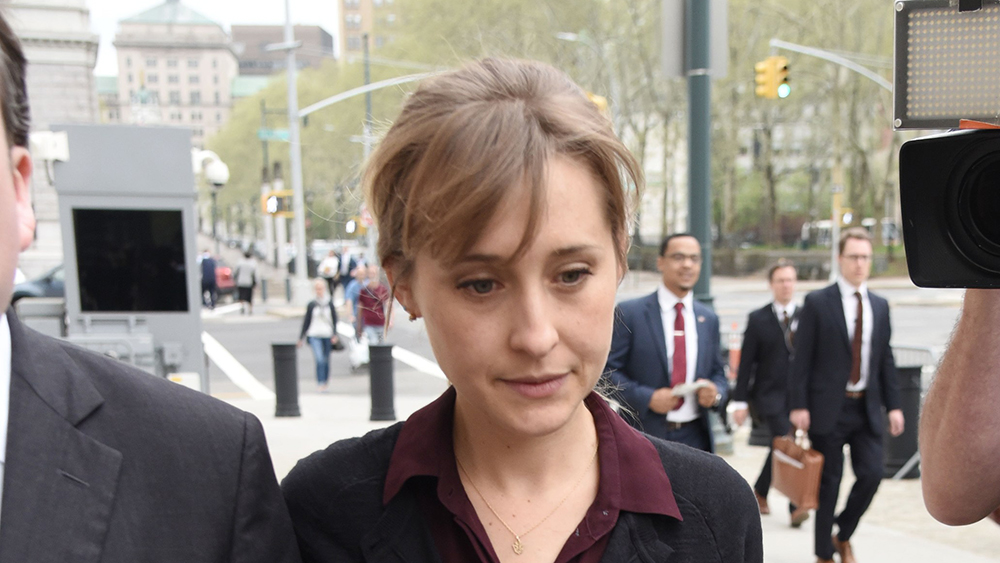
Allison Mack arrives at a bail hearing in Brooklyn on May 4, 2018
Courtesy of Derek Storm/Everett Collection
Sorry, this was in the months after you’d already spoken with Allison?
Robehmed: Yes, in the months after. It was late. I said, “If you feel comfortable, will you send Lauren a text for me, and just tell her about this project?” He did, and I spoke to her a couple times, and then got her to agree to go on the record for the first time. Which was, for the story, fantastic. As a NXIVM-head, this is an under-trumpeted part of it — Lauren Salzman speaking.
I’m going to trumpet it.
Grigoriadis: She’s incredible. And the interplay between the two of them — Allison really decided to flip after Lauren told her that they were wrong: that this didn’t happen in the way that they all believed.
As a subject, Lauren Salzman is so different from Allison Mack, in that she came to the Keith Raniere realizations much sooner, and seems much more clear and definitive about it. Can you talk about how you wanted to represent her story in contrast to Allison’s?
Grigoriadis: I guess I would answer that by saying we feel that Allison is incredibly compelling, and she has it worked out in her mind that she was played for a fool by Keith Raniere. She understands that. I think the real difference is that Allison is highly emotional, like a lot of actors, and almost somatic, in a way. You really need to be in the room with her, because she’s expressive through her entire body, whereas Lauren is just this very linear thinker.
Robehmed: Matter of fact.
Grigoriadis: Very intellectual. Feels like maybe she’s on a higher level of Tetris or something, the way that she’s put this all together. Which is part of why she was a leader in the group, in terms of people really looking up to her. The two of them complement each other incredibly well, because you hear from Lauren somebody who is — I don’t want to say has come out the other side, because —
Robehmed: She was just visibly nervous. You can tell when somebody’s uncomfortable. It was a big deal for her to talk. I think I say this in the podcast: It was huge deal for her to talk to me. Really. And you could see that.
I mean, her mother, Nancy Salzman — I don’t know if you listened to the Kate Casey podcast she was on recently, but hoo boy.
Robehmed: Yes. I was the guest the week before, and then it was Nancy Salzman. Look, Lauren Salzman could have done a whole project on her own. Her story is so interesting, in and of itself. I had no idea that she had even been in the room with Keith when the federales burst in. I did not know that until we were doing the interview, and I was asking her about being in Mexico, and then she was giving me the blow by blow. Just that tick-tock of exactly how it happened and what went down was so valuable.
I think for me, being able to see the way that two very different women were both taken in and manipulated by the same man is fascinating. Because he did different things to each of them, and played them differently. Because that’s what he was good at, you know?
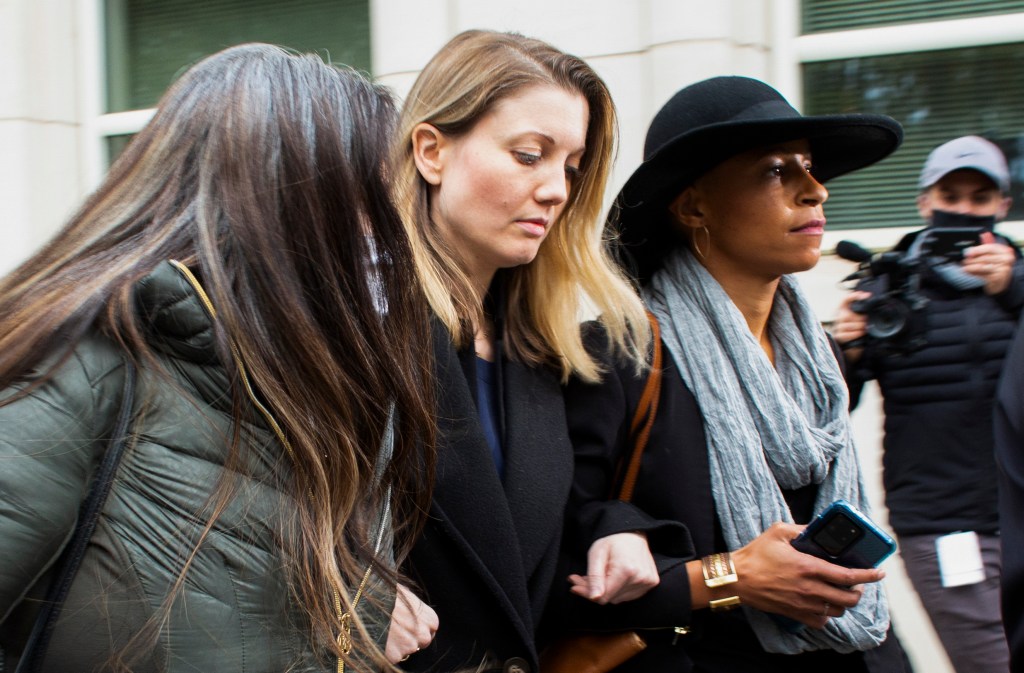
Nicki Clyne leaves court after Keith Rainiere was sentenced to 120 years in prison on October 27, 2020
Courtesy of KENA BETANCUR/AFP via Getty Images
You have the statement from India Oxenberg. As far as other NXIVM survivors, were there people that you tried to get and would have wanted to get?
Robehmed: I would have loved to have spoken to Nicki Clyne. And we did reach out to her, and she ultimately decided not to participate. Nicki Clyne, obviously, was another Canadian actress who was actually married to Allison at one point.
Grigoriadis: I became very interested in Natalie and Allison’s voices together leading us through this podcast. Where podcasting is right now, it’s all interview shows — that’s what people really want. They really want an intimate experience of somebody telling you their life story, and the narrator supporting that. And I think we had a beautiful pairing there. We got really lucky with Lauren. And I think Allison’s mom is also great. I’m also in the podcast. There’s so much archival of NXIVM, my God, because they recorded everything. As a piece of artwork, I prefer it the way that it is now.
I just meant was there a dream interview that you didn’t get.
Grigoriadis: We were very honest that this was an Allison Mack podcast. So you have people who either want to tell their own story, on their own terms — why would I participate in Allison’s? Or people who don’t want to talk about just Allison. Remember, she hasn’t legally been allowed to connect with a lot of people. These people had deep relationships with each other in the cult. So it was sort of a weird ask in some ways? Which is why there were some people who said yes, and then they backed out.
What Allison told us — and she says it on the podcast — is “I owe it to myself to say this out loud once. That this is the way it really happened.” With Lauren — I didn’t talk to her, Natalie did — but maybe it’s a similar thing. She could obviously have done a documentary, she could have done better! It’s a public broadcaster! There’s cushier platforms out there!
We’re talking about people who were in a cult that was about human potential and growth. And for their own healing and growth, I think they wanted to talk about it. But I want to be clear: Alison Mack has not read anything about herself for six or seven years at least, OK? She’s really not computer literate whatsoever. She said she couldn’t even look at anything. So she’s coming from a totally different mindset. Plus, she was in NXIVM for a very long time, which was a closed community.
I think that people want her to be like a Sydney Sweeney, where she’s like — she’s savvy, she’s in the game, she’s playing the game. This is not that person. That is just not who she is.
When the project was announced, there were no shortage of people whose knee-jerk response was to automatically criticize “Allison After NXIVM” for the mere fact of giving her a platform. And you obviously did this podcast, which is one answer to what you think of that conceptually. But what do you think of that idea in general? About platforming people who’ve done wrong? Specifically, in this case, Allison Mack.
Robehmed: I take issue a little bit with the verb “platforming” — because yes, I see how what we were doing could be perceived as that. But I felt that I was questioning her, and interrogating her story. You hear my ambivalence within the podcast. This was not a chat show. As Vanessa pointed out, there could have been much cushier platforms for this. This was not a “Call Her Daddy” or an Oprah interview, or a cozy sort of sit down where it’s just no hard questions. Not at all. So while I hear that concern, I personally ultimately felt that interrogating why she did what she did was more important so that we could learn and understand it, and hopefully not repeat it.
Ultimately, there’s bigger questions here than just Alison Mack. She went to prison. She served the time that she was sentenced to — she served two years of her three-year sentence. In the eyes of the law, she’s done her time. She’s back in society. So what do we do with people like her? What do we do with people who’ve done wrong? What do we do with convicted felons? Alison Mack is somebody that already had a platform before she went into NXIVM. You know, she was famous! Like, let’s not get it confused. She was famous, and that’s why so much of this case has centered around her — because she’s a famous person, you know?
And that was part of the question as well for me. How does somebody who has it all — who’s both famous and attractive and a successful Hollywood actress — how does she end up in a sex cult? Because if it can happen to her, who else can it happen to? I just encourage everyone to go listen to it, and make up their own minds.
Grigoriadis: All the ex-NXIVM members have many different points of view. Clearly. But she’s renounced Keith. She’s taken responsibility for what she did. She’s volunteering in prison. She’s trying to become a social worker. There’s, I think, a feeling that everybody wants to heal from this. These people were, a long time ago, very close, right? We have no idea if they’ll all ever speak again, or if they would want to — time will tell what happens with all of them.
To go back to the platforming thing for a second, I do feel the way that Natalie feels — she’s done her time. She was not paid for this.
Robehmed: She did not get editorial oversight. I want to make that clear.
Grigoriadis: She didn’t get hear it; she didn’t tell us that she wasn’t going to answer certain questions — nothing was off the table.
You know, any documentary that you see that’s made these days of something of this caliber comes with so many rules that it’s like a straitjacket for a lot of filmmakers. She didn’t even ask for anything. We didn’t have to say no, because she didn’t ask! The really interesting thing about Allison, in the end, may be that what she has at her core is trust. And she trusts people, and she trusted us — and she trusted Keith. It’s sort of weirdly what makes her special as a person.
She’s said that she acted horribly, she did all these things that are the regrets of her life. But she’s still a person that is moving through the world without feeling besieged. Although, as she says, she will be recognized for the rest of her life by her face. She can’t just dye her hair and not be Allison Mack anymore. She will always be that person.
So what do you think remain the great still untold stories of NXIVIM?
Robehmed: Clare Bronfman.
Grigoriadis: The Bronfmans, generally. Mexico: What happened with all of the sons and daughters of the big politicians and media moguls in Mexico? Because it’s probably a pretty similar story to what happened here, but we just don’t know any of it. I think those are, those are the big ones. But there’s countless others, because there’s tons of people who haven’t talked. But I think they start to feel a bit derivative.
Not to me! Could this continue in some form? Why is Natalie laughing?
Robehmed: Sorry, I’m laughing because we need a break from this story. Me and Vanessa personally! Us.
Grigoriadis: I didn’t want to host this, because I didn’t think I could do it again. I didn’t think I could think through NXIVM this much. And it was very upsetting for Natalie. Like, it gets into your psyche. You can’t believe that somebody has engineered something that’s so perfectly evil. Sorry, Natalie.
Robehmed: No, come on.
Grigoriadis: It’slike a mind twister. I mean, that’s why you’re still interested in it. That’s why we’re sitting here. Countless years later, everybody will be still talking about this story, because it hits at so many levels.
Robehmed: Exactly as Vanessa said, it gets under your skin, even as a reporter. Just hearing somebody say a lot of the stuff, and really sitting with the realities of it, and how it worked and the psychological warfare going on — it stays with you, however boundaried you are, however good you are leaving your work. Like, it stays with you.
Do have any idea where Clare Bronfman is? Has she ever renounced Keith?
Robehmed: Not that I know publicly. I don’t know. That’s a big question mark. I would love to know. Clare, if you want to talk!
There you go. Put the sign out.
Robehmed: Clare’s reading Variety!
This interview has been edited and condensed.